Everyday blends of nuts, seeds, and fruits simple, satisfying, and ready to enjoy anywhere.

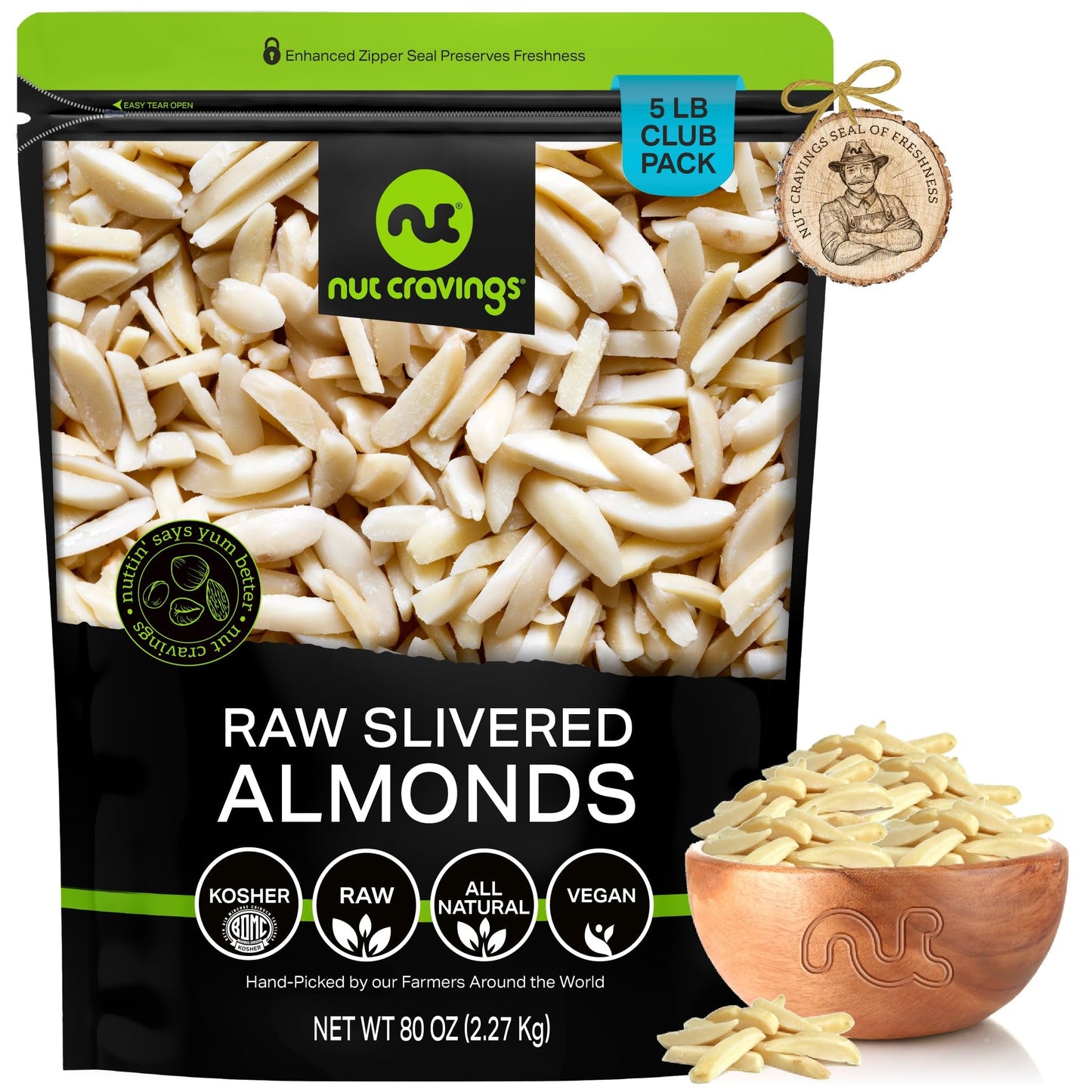
Slivered almonds are the version every baker, salad maker, and green bean almondine fan actually reaches for. They're whole raw almonds sliced into thin matchstick strips, which means more surface area, faster toasting, and better integration into whatever you're making. A handful of slivered almonds scattered over a spinach salad does what a handful of whole almonds can't. The texture is different, the toast is different, the way they coat each bite is different.
Ours are raw, unsalted, and sliced with the skin left on. Skin-on slivers carry more flavor, more antioxidants, and hold up better under heat than blanched white slivers (which are prettier but flatter-tasting). Sourced from California Central Valley almond growers, slivered at scale, and packed within weeks into resealable stand-up bags at our Monroe, NY facility. kosher certified.
Prices run $14.97 for 1 lb up to $40.97 for 5 lb, which works out to $8.19 per pound at the bulk size. For reference, the brand-name slivered almonds in most grocery aisles run $8 to $10 for a 6 oz bag, which is roughly $21 per pound. If you bake regularly, cook Asian or Mediterranean dishes, or run a small cafe or catering kitchen, the 3 lb or 5 lb sizes are the obvious move.
What You're Buying
-
Form: raw slivered almonds, thin matchstick cut, skin on
-
Processing: raw only, no roast, no salt, no oil, no blanching
-
Origin: California, Central Valley growers
-
Packaging: resealable food-safe stand-up bag
-
Shelf life: 6 to 9 months pantry, up to 2 years refrigerated, 2+ years frozen
-
Kosher: certified
-
Allergen note: tree nuts, processed on shared equipment with other tree nuts and peanuts
Skin On vs Blanched
Most grocery slivered almonds are blanched, meaning the brown skin has been removed before slicing. Blanched looks cleaner and cooks up paler, which bakeries prefer for visual reasons. Skin on keeps the flavor compounds concentrated in the outer layer, gives you a more toasted, nuttier taste when pan-fried, and holds the cut shape better during long bakes without going soggy.
If you're making classic French pastry where the visual calls for white slivers, blanched wins. For everything else (savory cooking, granola, salads, trail mix, most American baking), skin on is the better buy.
Nutrition per Ounce (About 1/4 Cup Slivered)
-
164 calories
-
6g protein
-
14g fat, mostly monounsaturated
-
3.5g fiber
-
2.5g net carbs
-
37% DV vitamin E
-
19% DV magnesium
-
14% DV manganese
-
Solid riboflavin, copper, phosphorus
Nutrition is essentially identical to whole raw almonds. The slivered cut doesn't change what's inside, just how fast your body (and your pan) processes them.
How People Use Them
Green bean almondine. Toast 1/4 cup slivered almonds in butter until golden, toss with blanched green beans, finish with lemon zest. Five-minute side dish.
Asian chicken salad. Scatter raw over shredded cabbage, carrots, chicken, and a sesame-ginger dressing. No toasting needed, the crunch works cold.
Almond croissants. Essential for the classic topping, mixed with frangipane.
Granola and trail mix. Toast at 325°F for 8 to 10 minutes with a drizzle of honey and oats, cool, store in a jar.
Fish dishes. Trout amandine, sole meunière, any pan-fried white fish finished with brown butter and toasted slivered almonds.
Yogurt and ice cream topping. Toast ahead, keep in an airtight jar, sprinkle over anything.
Streusel and crumble toppings. Mixed with cold butter, brown sugar, and flour for pie and crisp toppings.
How Freshness Holds Up
Seal the bag after each use and store in a cool, dry spot. 6 to 9 months pantry life. Bulk buyers should freeze half on arrival, since slivered almonds (more surface area than whole) do oxidize slightly faster. Freezing adds 2+ years of shelf life and won't change the texture once thawed. Every order ships within 24 business hours from Monroe, NY.
Health Benefits of Raw Slivered Almonds
Heart Health: 2025 Global Expert Consensus and the LDL-Reduction Evidence ▾
- In April 2025, a peer-reviewed publication in Current Developments in Nutrition presented the findings of the global almond cardiometabolic roundtable eleven scientists and physicians who unanimously concluded that eating almonds daily has meaningful benefits for cardiometabolic health. The consensus identified four specific mechanisms: reducing LDL cholesterol, modestly decreasing diastolic blood pressure, aiding in healthy weight management, and supporting gut health. This applies fully to slivered almonds because the nutritional content per ounce is identical to whole raw almonds only the physical form changes.
- A 2025 systematic review and meta-analysis published in Nutrients (Musa-Veloso et al.) examined 36 randomized controlled trials involving 2,485 adults. The review found that almond consumption significantly improves blood lipid markers, particularly in people with elevated LDL cholesterol, and confirmed a positive effect on the ApoB:ApoA ratio a key marker of heart health not previously well characterized in earlier almond reviews. Phytosterols in almonds help block cholesterol absorption alongside heart-healthy fats and vitamin E.
- A 2024 comprehensive review published in Nutrients (PMC11207051) confirms almonds improve lipid profiles by reducing LDL cholesterol and enhancing HDL functionality, and additionally aid in glycemic control, blood pressure reduction, and chronic inflammation amelioration. The slivered format in cooking and baking applications may actually increase total daily almond consumption for buyers who use slivered almonds across multiple meals per day granola at breakfast, salad at lunch, a finished fish dish at dinner distributing the cardiovascular benefit across a broader dietary pattern.
Vitamin E: 37% Daily Value Per Ounce - Why the Slivered Format Does Not Reduce This ▾
- Slivered almonds provide approximately 37 percent of the adult daily vitamin E requirement per ounce (approximately 7.27 milligrams of alpha-tocopherol) per USDA FoodData Central identical to whole raw almonds. The slivering process is mechanical, not chemical: the almond is split or sliced along the length of the kernel. No heat, no solvent, no blanching chemical (this product uses skin-on, not blanched white slivers). The vitamin E content of the kernel is fully preserved. No other commonly eaten tree nut matches this vitamin E concentration per ounce.
- A 2025 Oregon State University randomized controlled trial (Nutrition Research, Emily Ho, NCT05790564, Linus Pauling Institute) found that daily almond snacking improved vitamin E (alpha-tocopherol) status and plasma LDL-C and total cholesterol concentrations in participants with metabolic syndrome. The skin-on format in these slivered almonds specifically retains the pellicle polyphenols (catechins, epicatechins, kaempferol, isorhamnetin) that work synergistically with vitamin E converting by gut bacteria into bioactive anti-inflammatory metabolites. Blanched slivered almonds remove this pellicle layer entirely, losing those polyphenols. Skin-on slivers deliver the full antioxidant profile that blanched white slivers cannot.
Blood Sugar and Glycemic Control: Why Almonds in Food Applications Beat Processed Snacks ▾
- At approximately 2.5 grams of net carbohydrates per ounce and a glycemic index of essentially zero, raw slivered almonds have no meaningful impact on blood glucose. The 2024 comprehensive review (PMC11207051) specifically confirms almonds aid in glycemic control as a key metabolic health benefit. When slivered almonds are incorporated into dishes like granola, salads, and yogurt parfaits the most common use patterns reported by verified buyers they moderate the overall glycemic impact of those dishes by slowing glucose absorption from the carbohydrates present in the other ingredients.
- This glycemic moderating effect of almonds in composite foods is a specific nutritional advantage of the slivered format. Scattering slivered almonds over a grain bowl, folding them into granola, or topping a breakfast parfait adds protein (6g per oz), fat (14g per oz), and fiber (3.5g per oz) to carbohydrate-heavy meal components that would otherwise spike blood glucose faster. A 2021 study of 219 young adults found those who ate 56 grams of almonds daily had significant reductions in hemoglobin A1c (the three-month blood sugar average used to monitor diabetes) compared with a control group. Incorporating slivered almonds across multiple meal applications across the day may distribute this glycemic benefit more effectively than eating a single whole almond serving.
Magnesium: 19% Daily Value Per Ounce - 300+ Enzymatic Reactions ▾
- Raw slivered almonds provide approximately 19 percent of the adult daily magnesium requirement per ounce (approximately 77 milligrams) per USDA FoodData Central identical to whole raw almonds because the slivering process is purely mechanical. Magnesium is required as a cofactor for over 300 enzymatic reactions in the body, including ATP synthesis (cellular energy production), insulin receptor signaling (blood sugar regulation), cardiac muscle function, and neurotransmitter synthesis. Magnesium deficiency affects an estimated 50 to 60 percent of the US adult population.
- The 2025 global expert consensus (Current Developments in Nutrition) confirms magnesium in almonds contributes to the blood pressure reduction mechanism observed in almond cardiometabolic research. For buyers who use slivered almonds primarily in cooking and baking applications, the magnesium contribution is distributed across multiple servings across the day morning granola, afternoon salad, evening fish dish rather than concentrated in a single snack serving. That distributed pattern may support more consistent daily magnesium intake than less frequent whole almond consumption.
Protein and Fiber: 6g Protein and 3.5g Fiber Per Ounce in a Culinary Format ▾
- One ounce of raw slivered almonds (approximately one quarter cup) provides 6 grams of protein and 3.5 grams of fiber identical to whole raw almonds. The protein-fat-fiber combination creates meaningful satiety at a modest serving volume. For the granola and parfait buyers who are the primary verified buyer group for slivered almonds, incorporating a quarter cup of slivered almonds into a breakfast application adds 6 grams of plant protein and 3.5 grams of fiber to what is otherwise often a low-protein, moderate-fiber meal. That macronutrient contribution specifically extends morning satiety and reduces mid-morning hunger significantly compared to a nut-free granola or parfait.
- Almonds have one of the lowest saturated fat profiles of any tree nut at approximately 1.1 grams of saturated fat per ounce alongside approximately 8.8 grams of heart-healthy monounsaturated oleic acid. The 2025 Nutrients meta-analysis (Musa-Veloso et al., 36 RCTs, 2,485 adults) confirmed that this fat profile, combined with fiber, vitamin E, and phytosterols, produces significant LDL cholesterol reduction in clinical trials. In cooking applications green bean almondine finished in butter, fish amandine with brown butter the monounsaturated fat in the slivered almonds is a specifically heart-health-appropriate fat to pair with even small amounts of saturated dairy fat.
The Skin-On Advantage: Pellicle Polyphenols That Blanched Slivers Lose ▾
- The thin brown skin (pellicle) on these skin-on slivered almonds is the primary location of the almond's polyphenol antioxidants, including catechins, epicatechins, kaempferol, and isorhamnetin. A 2014 study in Antioxidants and Redox Signaling found that almond skins increase the antioxidant capacity of the gut following consumption, specifically through the production of flavonoid metabolites by gut bacteria from the pellicle polyphenols. These gut-produced metabolites have documented anti-inflammatory activity beyond what the kernel alone provides.
- Blanched slivered almonds the standard product in most grocery stores remove the pellicle entirely before slicing. This eliminates the pellicle polyphenol contribution completely. Skin-on slivered almonds retain these polyphenols and deliver them into the food matrix during cooking and eating. For buyers who are choosing between skin-on and blanched slivered almonds primarily for nutritional reasons (rather than appearance), skin-on is the nutritionally complete choice. The visual difference in finished dishes is subtle; the nutritional difference between skin-on and blanched is not.
Gut Health: The Slivered Format and Prebiotic Fiber Delivery ▾
- The 2025 Oregon State University RCT (NCT05790564) found that daily almond snacking improved biomarkers of gut barrier function and intestinal inflammation in participants at baseline. The 2025 global expert consensus specifically identifies supporting gut health as one of the four key mechanisms by which almonds impact cardiometabolic health. The prebiotic fiber in slivered almonds (3.5 grams per ounce, primarily insoluble fiber) feeds beneficial gut bacteria, particularly Lactobacillus and Bifidobacterium species.
- The slivered format may deliver prebiotic fiber more efficiently across a day than whole almond snacking because slivered almonds are incorporated into multiple meal applications granola, salads, parfaits, cooked dishes that distribute fiber intake across breakfast, lunch, and dinner. The 2024 comprehensive review (PMC11207051) confirms the antioxidant properties of almonds, primarily due to their high vitamin E content and polyphenol profile, help reduce oxidative stress markers. Skin-on slivers retain both the fiber and the pellicle polyphenols that together support the dual gut-health mechanism.
Manganese and Riboflavin: The Micronutrient Profile Is Identical to Whole Almonds ▾
- Raw slivered almonds provide approximately 14 percent of daily manganese per ounce (approximately 0.65 milligrams) and approximately 25 percent of daily riboflavin (vitamin B2) per ounce (approximately 0.32 milligrams) per USDA FoodData Central the same values as whole raw almonds. Manganese is required for MnSOD (the mitochondrial antioxidant superoxide dismutase enzyme), for the glycosyltransferases that build the proteoglycan matrix of cartilage and bone, and for the gluconeogenesis enzyme pyruvate carboxylase. Riboflavin is required for FAD coenzyme function in the mitochondrial electron transport chain and for the glutathione reductase antioxidant enzyme.
- The copper contribution of approximately 32 percent DV per ounce and the calcium contribution of approximately 6 percent DV per ounce are also preserved identically in the slivered format versus whole almonds. Copper is required for lysyl oxidase (collagen and elastin cross-linking in arterial walls and connective tissue) and CuZnSOD (the cytoplasmic antioxidant enzyme). For buyers building a regular daily almond habit through cooking and baking applications, the distributed slivered almond consumption across multiple meals per day supports more consistent daily intake of these micronutrients than a single snack serving of whole almonds provides.
Why Slivered Almonds Are the Volume Buyer's Best Almond Format ▾
- The per-ounce cost comparison makes the case clearly: brand-name slivered almonds in most grocery aisles run $8 to $10 for a 6-ounce bag, which is $1.33 to $1.67 per ounce. The 2 lb size of these NutCravings slivered almonds at $19.97 works out to $0.62 per ounce less than half the grocery store rate for an equivalent product that is actually inferior (most grocery slivered almonds are blanched, losing the pellicle polyphenols). For home bakers, granola makers, regular salad preparers, and small cafe or catering operations that go through slivered almonds in volume, the 2 lb size saves meaningfully versus weekly grocery store purchases.
- The Subscribe and Save 5% option at $14.22 per pound for the 1 lb recurring delivery is specifically appropriate for buyers with a consistent weekly baking or cooking routine. The verified buyer making grandma's signature cookies and the granola makers who account for three of eleven reviews are the natural Subscribe and Save buyers they have a predictable cadence that the subscription model serves better than reordering when they run out. The skin-on format's comparable shelf life to whole almonds (6 to 9 months pantry, 2 or more years frozen) means a monthly or bimonthly subscription delivery accumulates without freshness loss.
Nutrition Facts and What They Actually Mean
Per one ounce (28g), approximately one quarter cup of raw slivered almonds. Values from USDA FoodData Central for raw almonds, shelled nutritionally identical to whole raw almonds because the slivering is a purely mechanical cut. Note: the 185 cal / 18.5g fat / 24% DV values in the reference image are raw walnut values and do not apply to this product. Correct raw slivered almond values: 164 cal / 14g fat / 18% DV per ounce. All "N/A" values replace any throughout this document.
| Nutrient | Per 1 oz | %DV |
|---|---|---|
| Calories | 164 | 8% |
| Total Fat | 14g | 18% |
| Saturated Fat | 1.1g | 6% |
| Trans Fat | 0g | 0% |
| Cholesterol | 0mg | 0% |
| Sodium | 0mg | 0% |
| Total Carbohydrate | 6.1g | 2% |
| Dietary Fiber | 3.5g | 13% |
| Net Carbohydrates | 2.5g | -- |
| Total Sugars | 1.2g | -- |
| Added Sugars | 0g | 0% |
| Protein | 6g | 12% |
| Vitamin E | 7.27mg | 37 to 50% |
| Magnesium | 77mg | 19% |
| Manganese | 0.65mg | 28% |
| Phosphorus | 137mg | 11% |
| Iron | 1.05mg | 6% |
| Potassium | 208mg | 4% |
Frequently Asked Questions
We’re More Than Just Snacks
Everyday blends of nuts, seeds, and fruits simple, satisfying, and ready to enjoy anywhere.
Beautiful assortments made to delight perfect for birthdays, holidays, & heartfelt thank yous.
Pure and certified organic — clean, natural ingredients for mindful snacking.
Limited-edition assortments inspired by every season and celebration.
Chocolates, brittles, and confections that turn any snack break into a special moment.
Protein-packed combinations of nuts, seeds, and fruits crafted for energy and wellness.
Thoughtful boxes filled with joy and flavor — send care to friends, family, or colleagues.
Elegant, customizable boxes designed to impress teams, clients, and partners.